Remembering Jane McAlevey
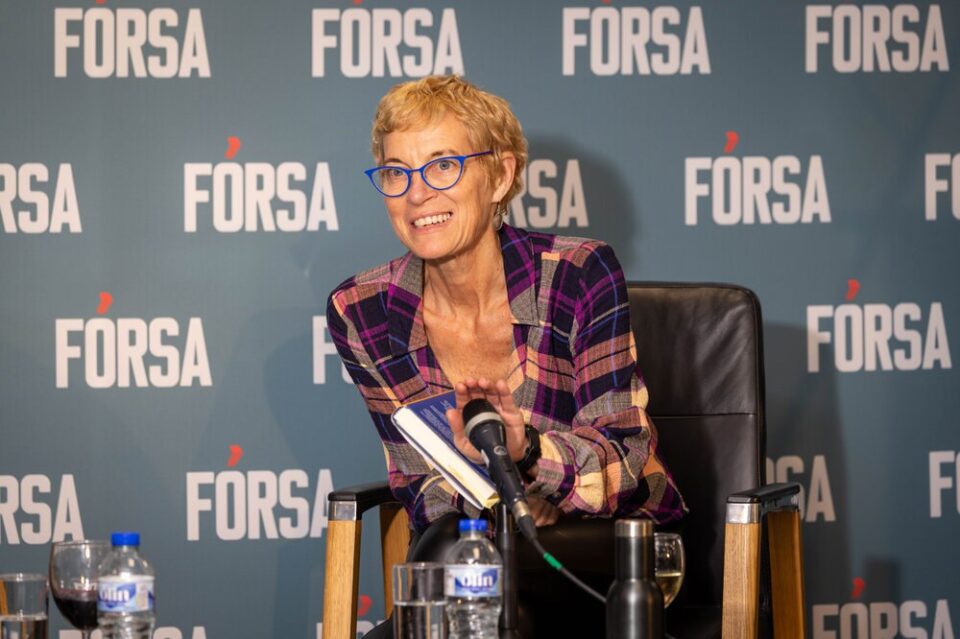
Photo: Fórsa
Jane McAlevey died on 7 July 2024 at the age of 59 following a battle with multiple myeloma. Ethan Earle, Organizing for Power’s co-founder and general coordinator wrote some words in tribute of Jane upon her passing.
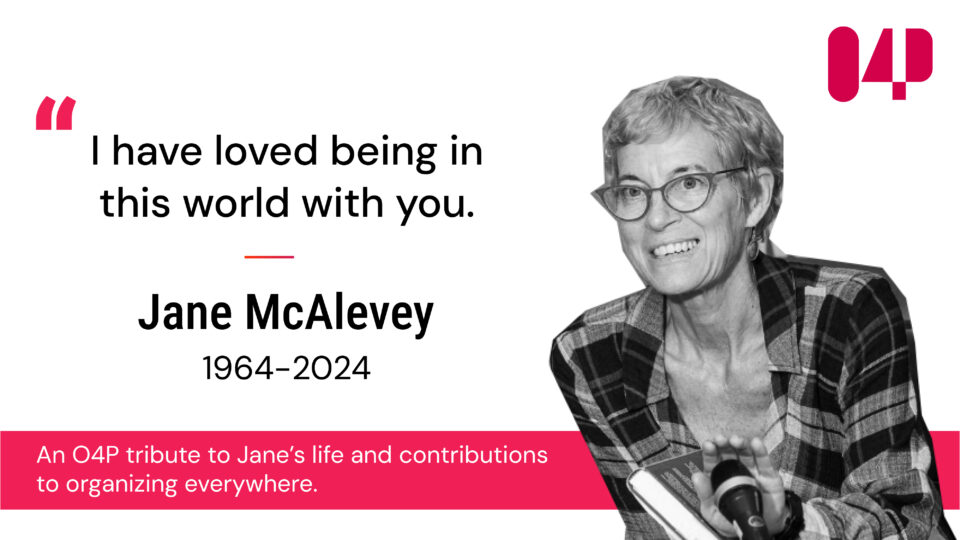 Senior Policy Fellow at the University of California at Berkeley, Strikes Correspondent for The Nation magazine, long-time political actor, commentator, and educator, campaign strategist, and union organizer — Jane leaves us with a rich lifetime of work to study, understand, and, most importantly, implement in our own organizing in the struggles to come.
Numerous tributes to her remarkable record — four books published in the past decade, alongside a life’s work of training organizers based on well-documented campaign victories — will surely be published in the coming months. I will not attempt to do justice to the fullness of Jane’s amazing life but rather focus on how I knew her best: as a big-hearted humanist and beacon to the international workers’ movement.
Jane’s father, John McAlevey, was a World War II fighter pilot who later became an important progressive politician in New York state politics. Her mother died when she was young, and she would often accompany her father as a “campaign prop”, as she would later say, only half-jokingly. From her father, she developed a lifelong hatred for fascism and learned what it takes to fight and win in the trenches of political struggle. From her mother, she learned that life is fleeting, and not a second of it should be wasted.
Jane got to work young, as a student organizer and outspoken critic of US foreign policy. As president of the Student Association of the State University of New York, she led a campaign that resulted in a historic act of divestiture from Apartheid South Africa. After university, she travelled to Nicaragua to support the revolution led by the Sandinista National Liberation Front. There, she learned another key lesson from a Sandinista, who told her that if she was truly committed to dismantling US imperialism, she should go back to fight from within the belly of the beast. Always a close listener, Jane did just that.
Back in the US, Jane spent several years in the environmental movement, followed by a spell at the Highlander Research and Education Center, which famously trained a generation of civil rights leaders including Martin Luther King, Jr. and Rosa Parks. Jane would later speak about how popular depictions of Parks implied that she appeared out of nowhere on that bus in Montgomery, when in fact it was the apotheosis of years of training and disciplined movement building.
While studying at Highlander, Jane had an epiphany that would stay with her until the very end: None of the most important struggles of our time — from women’s liberation to racial equality, from climate justice to an end to war — could be won without bringing majorities of working people on board. She followed this conclusion to its only logical starting point, the labour movement, beginning with the American Federation of Labor and Congress of Industrial Organizations, and subsequently moving onto the Service Employees International Union. Over the next two decades she would go on to work with more unions and campaigns than can be listed in the space of one article, and remained in the labour movement for the rest of her life.
Fighting for Workers’ Rights
From Nevada to Philadelphia, Los Angeles to Berlin, Jane played a critical role in winning numerous high-participation union campaigns, bringing material gains to many hundreds of thousands of workers. While her fellow travellers are the ones who should write those battles’ elegies, I will limit myself to saying that she stared down long odds, tough opponents, and nasty union-busting campaigns with courage, conviction and — most memorably — meticulous planning.
It was Jane’s deep belief that workers should never be led into a fight if they were not adequately prepared and did not stand a good chance of winning. That did not mean she was afraid of defeat — and, like any serious organizer, she did sometimes lose, both in campaigns and in the tough internal disputes that scar the trade union landscape — but she never threw workers to the wolves, and she never went down easy.
Jane’s core theory of labour organizing, as it developed through her campaign experiences, was that American trade unions had moved away from the kind of organizing developed in the first half of the twentieth century in favour of what she called “shallow organizing”. The same approach is more commonly known as mobilizing: essentially getting people to turn out to large demonstrations without any plan for what to do beyond the demonstration.
Jane argued that this trend must be reversed, for the sake of workers and the planet that we share, and that what she called “whole-worker organizing” was key to building disciplined majority-led campaigns capable of credibly threatening and executing escalatory actions — up to and including strikes — to win demands. This argument, as well as a comprehensive outline of the methods that this deep organizing entails, was laid out in a series of books that she began to write with her characteristic frenetic energy after being convinced, at the age of 45, to return to graduate school at the City University of New York under the tutelage of renowned sociologist Frances Fox Piven.