How Slovenian supermarket workers organized and won big
In Slovenia, workers of one of the biggest national supermarket chains, Tuš, faced catastrophic working conditions. Their wages were low, they were understaffed, and they faced systematic labor violations, including wage theft and arbitrary transfers between branches. Management ruled with fear, keeping workers isolated and exploited.
At the start of 2021, a three-year long organizing campaign was launched. A few of its organizers had followed our Organizing For Power trainings for years, and applied the methods we teach. Their efforts paid off: after three years of organizing, workers won, and they won big. But how did they succeed?
Building the union structure
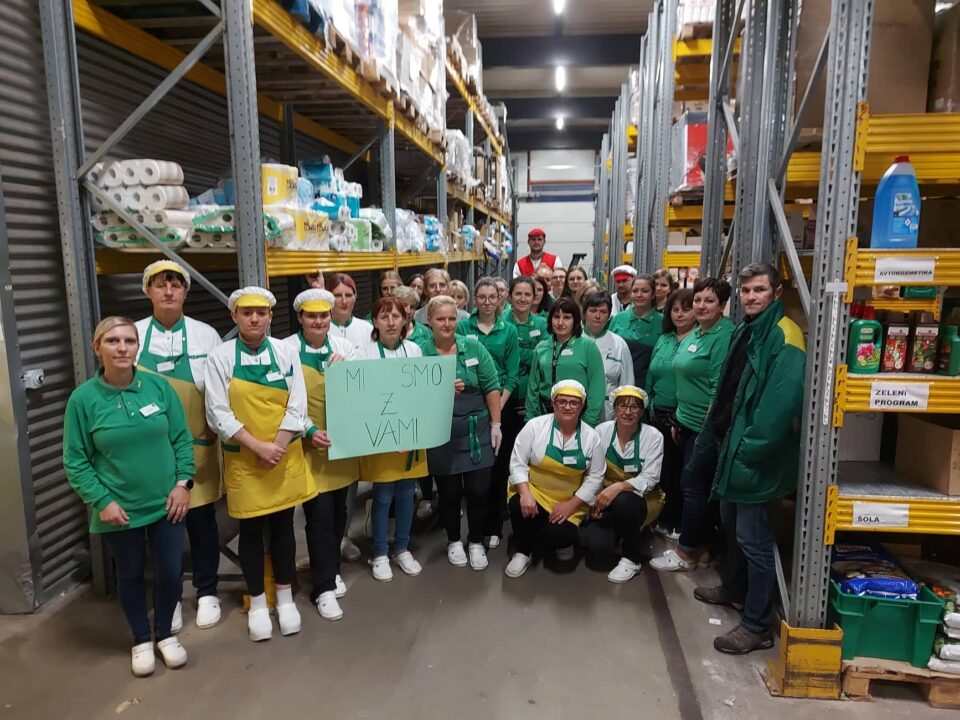
Organizing efforts kicked off with a first petition on a sectoral level to limit work on Sundays. This first initiative was a great success: the petition was signed by 6,000 people, including workers and their larger community, leading management to accept its demands. This first victory created momentum: a new union was formed, with the support of the Center for Social Research (CEDRA).
Organizers started meeting workers to build their worksite structure. They visited supermarkets all over the country, conducting Structured Organizing Conversations to agitate, recruit, and address fears, using scripts and role-plays to prepare these conversations. Organizing methods were taught to workers, who began to systematically map their workplace, listing all employees and identifying Organic Leaders: influential workers who are key to building powerful majorities.
Base-building is a crucial step in organizing. Creating systems to speak to every single worker, using tried-and-tested methods to recruit them, and forming strong social bonds in worksites are essential steps to build powerful majorities. All are key to empowering people, to raise their expectations, allow them to overcome their fears, and start taking risks — things shallow communications through social media campaigns cannot achieve.
Escalating actions lead to first successes
The first public action took place in 2022, with the publication of a petition summarizing workers’ demands. Membership started growing, and local groups were formed in dozens of branches. As the structure became stronger, the union escalated actions strategically. When membership was strong enough, a campaign was launched to increase workers’ wages, leading to a protest in front of Tuš headquarters and a strike announcement. These first efforts paid off: by then, the union had accumulated enough power to increase the minimum base salary by 36%, increase lunch compensations, and obtain the reimbursement of travel expenses.
After a single year of organizing, the union had recruited 510 members across 87 branches. But organizers didn’t stop there, and continued to escalate with a petition to strike, signed by 1,100 workers. This forced management to make more concessions at the end of 2022: workers received another wage increase, and obtained the limitation of worker transfers between branches and the compensation of these transfers. A new system was also put in place to ensure all working hours were counted.
Striking for groundbreaking benefits
Management backlash began in earnest after these victories: bosses started dismissing workers, outsourcing jobs, and reorganizing departments to stoke fear and mistrust, and break union membership. These challenging moments in organizing campaigns demonstrate the need for strong worksite structures. They underline the crucial role of Organic Leaders: trusted colleagues provided a strong base for workers to stand united, strong and motivated. Organizers had also prepared workers for management backlash through the inoculation method, which makes space for workers to anticipate and plan for repression tactics.
The union continued to defend new demands, including reduced working time and higher wages on Saturdays – eventually announcing a new strike. By that point, 70 branches were ready to strike, for the first time in the history of the retail sector in Slovenia. Outreach efforts with the local community bore fruits: the public was widely supportive of workers. A few hours before the strike was set to begin, management made its final offer, which the union accepted. Further salary increases were obtained, and negotiations began for the first-ever collective agreement at the company level.
Workers obtained the best conditions in the retail sector in Slovenia: the lowest wage was increased by 69% in total, with yearly increases. Advancements included non-economic gains to limit the flexibility of workers, with groundbreaking benefits: the limitation of worker transfers and temporary work, the restriction of unevenly distributed working time for workers over 55, paid trainings, the right to disconnect, paid care-taking leave and paid leave for victims of domestic violence.
Today, the union aims to continue expanding benefits, including new salary increases and reductions in working time. Workers and organizers are also reaching out to other companies in the retail sector to inspire and support organizing efforts in other companies.
“To everyone who is still hesitant on joining the union, I can only tell you that you have nothing to lose, your situation as a worker can only improve.” – Tuš worker
Find out more:
- Watch Jost and Jan explain the campaign in more detail during our last training here.
- Find out more about the campaign’s chronology here.
- Organize your community! Join our next organizing training in November here.